
Google Cloud Storage is scaling faster than most organisations can keep up with. Buckets routinely hold billions of objects and petabytes of data – driven by real-time analytics pipelines, cloud-native applications, and increasingly, the training data and outputs of AI workloads. The infrastructure is maturing fast. The data protection strategies around it, however, have largely stayed stuck in the past: expensive, operationally heavy, and poorly matched to how modern cloud environments actually work.
That gap matters more than ever. According to Commvault's own research, 55% of organisations lack confidence in their ability to recover systems and data following a major cyber incident. Meanwhile, 84% of cloud leaders now intentionally run multi-cloud to power AI, balance risk, and manage large datasets – yet protection across those environments still relies heavily on manual, time-consuming processes.
That is the gap Commvault is targeting at Google Cloud Next 2026 (April 22-24, Mandalay Bay Convention Center, Las Vegas – Booth #3617). At the event, Commvault is launching two significant new offerings: Clumio for Google Cloud and Commvault Cloud in the Google Cloud Marketplace. Both address the same core problem, and together they make a compelling case that the economics of cloud data protection are about to shift meaningfully.
The Real Cost Problem with Cloud Data Protection
Let's be specific about what is broken in the traditional approach, because the problem is not just theoretical overhead. The cost shows up directly on your cloud bill.
Versioning adds storage costs without giving you true resilience. Cross-region replication doubles your storage spend and still leaves you exposed to logical corruption or ransomware. Manual scripts require dedicated engineering time to build, maintain, and monitor. And most backup tools available through cloud marketplaces have historically required upfront capacity commitments – meaning you pay upfront for protection you might not fully use.
As a result, many organisations end up either over-protecting everything (expensive and wasteful) or under-protecting what matters (high-risk and potentially catastrophic). Neither is acceptable at enterprise scale, and neither reflects how organisations actually want to manage their cloud spend.
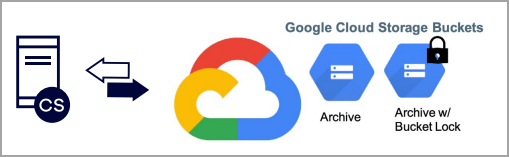
Two New Offerings from Commvault with One Clear Direction – Reduce Cost
Clumio for Google Cloud
Clumio runs entirely on Google Cloud Run and is designed specifically for organisations dealing with Google Cloud Storage at serious scale – we are talking tens or hundreds of billions of objects. The architecture scales automatically without any intervention, and critically, you never pay for idle compute resources.
Note: Clumio has been a Commvault company since September 2024.
The economics are straightforward: 100% pay-as-you-go. No servers to provision, no licences to purchase upfront, no fixed monthly fees. You pay for the backup operations and secondary storage Clumio consumes, and nothing else. If usage drops, so does your bill.
Clumio also extends Commvault's multi-cloud resilience story. It already protects AWS environments; with this announcement it brings the same immutable, air-gapped, SaaS-based recovery to Google Cloud Storage – backed by unified multi-cloud policies and isolated immutable vaults. Clumio for Google Cloud is available in early access now, with general availability targeted for summer 2026.
One of the more striking operational data points: customers report logging into the Clumio console roughly once every 30 days on average. The platform handles monitoring, remediation, and even proactive support ticket creation – notifying you once an issue is already resolved rather than requiring you to investigate it yourself. That reduction in operational overhead is real money, every month.
Clumio also backs up only changed objects using intelligent incrementals. There are no redundant full copies, which keeps secondary storage costs low even at petabyte scale – an important distinction from versioning-based approaches where every object change adds to your cumulative storage bill.
Commvault Cloud in the Google Cloud Marketplace
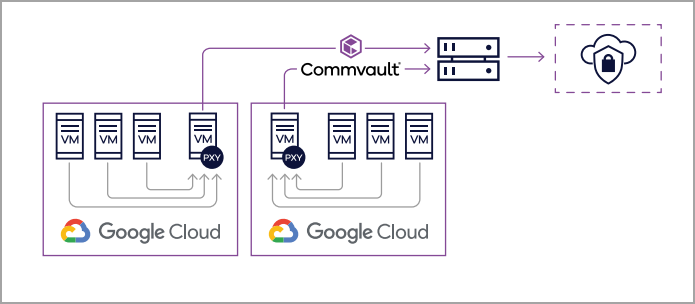
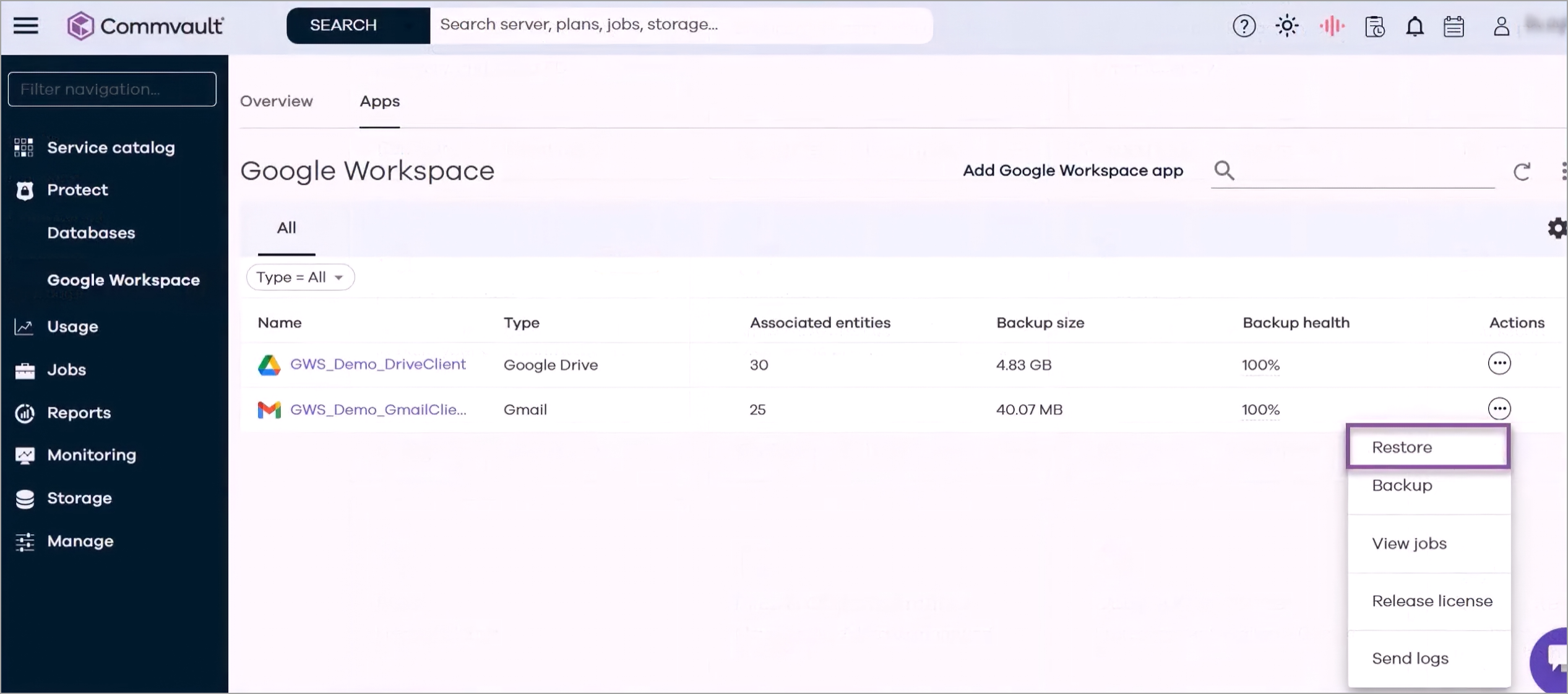
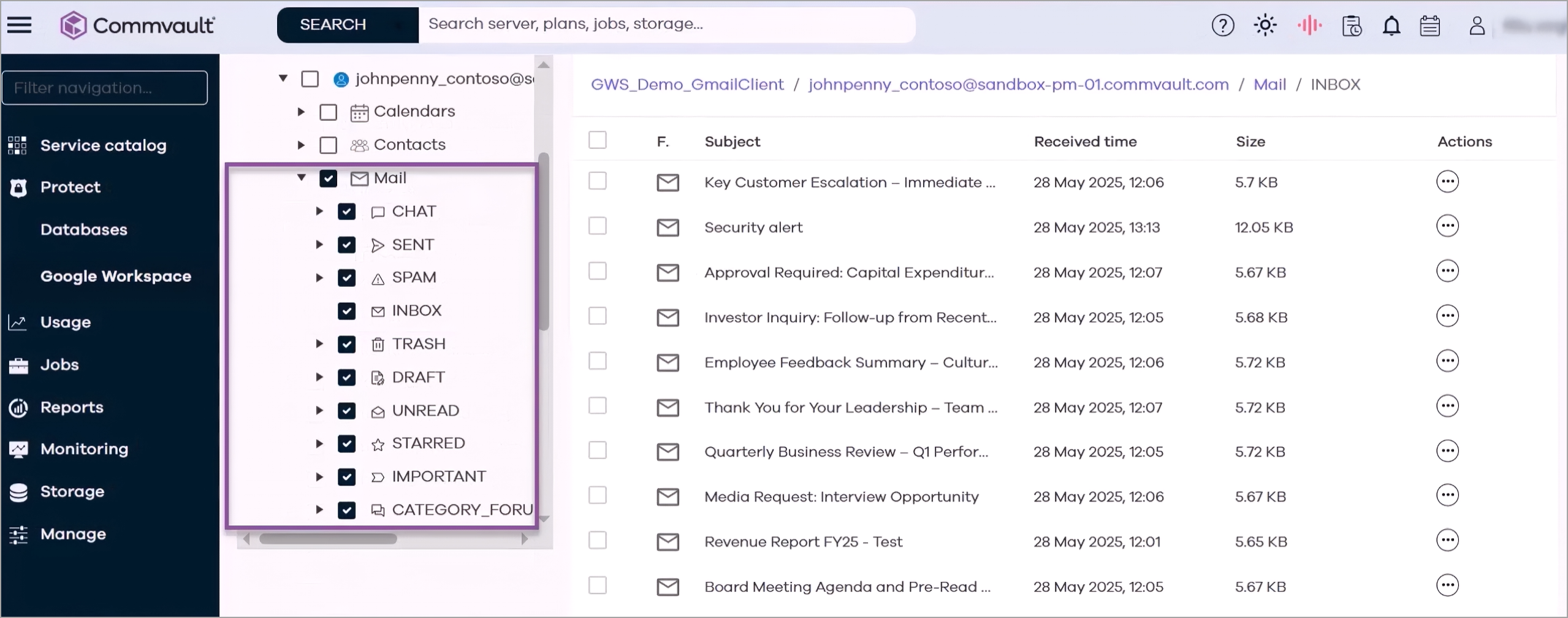
For organisations that need broader coverage – Compute Engine, GKE, BigQuery, Cloud SQL, Spanner, Gmail, Google Drive, the full stack – the Commvault Cloud offering on the Marketplace delivers a full-platform solution with minimal deployment friction. Pricing is delivered through a credit-based, utility-driven model that aligns costs with consumption and scales with customer needs.
The discovery model is worth highlighting: you provide a single IAM credential, and the service scans your entire organisation across all projects, automatically surfacing every workload and its current protection status. Cloud Data Risk Analysis then reports on protected vs under-protected workloads, so administrators can close gaps before they become incidents. That kind of continuous visibility is the foundation of any rational protection strategy – you cannot protect what you cannot see.
On top of that sits Arlie Advisor, an AI-driven recommendation engine that analyses your tags, workload types, and existing protection patterns, then suggests appropriate backup policies. It can recognise a “prod-database” tag and recommend daily full backups plus eight-hour incrementals automatically. It also generates a detailed TCO comparison – what you would pay using native Google tooling versus Commvault Cloud – before you commit to enabling protection.
Two further capabilities worth naming specifically: Commvault Cloud Threat Scan searches backups for known threats so you recover validated clean data and reduce reinfection risk; Commvault Cloud Air Gap Protect provides immutable, indelible backups isolated from production systems to defend against ransomware and insider threats.
Purchasing through the Marketplace also means your Commvault spend counts toward any existing committed use agreements with Google – no separate invoices, no separate contracts, and your existing volume discounts apply.
What the Numbers Actually Look Like – The Atlassian Example
The Atlassian case study is the clearest reference point available. They were managing a single S3 bucket containing more than 40 billion objects (later growing past 80 billion), relying on native tools and custom scripts. The results before Clumio: four-hour RPOs, recovery times measured in hundreds of days, and high ongoing management costs.
After migrating to Clumio:
- RPO reduced to 15 minutes
- RTO reduced to under two hours
- Total cost of protection cut by approximately 70%
The same architecture now protects their Google Cloud Storage buckets. These are not rounding-error improvements; they represent a fundamentally different operational and financial model. And Atlassian is not a small, easily optimised environment – they are one of the largest software companies in the world.
Why This Matters Beyond Cost
Cost reduction is the headline, but the capabilities unlocked by this architecture go further than just cheaper storage. Both offerings include:
- Logical air-gapped backups – protection against ransomware that native versioning cannot provide
- Threat scanning – active detection rather than passive storage
- Clean-room recovery validation – verifying recoverability before you actually need it (see my detailed article here)
- Fast restores at petabyte scale – because RTO matters as much as RPO
For AI-driven organisations in particular, the BigQuery capabilities are worth noting: point-in-time recovery, cross-project restores, and cross-region restores for the datasets powering your models, analytics pipelines, and business intelligence workloads. Data resilience for AI infrastructure is not a nice-to-have – model training and inference pipelines break in complicated ways when the underlying data is unavailable or corrupted.
Final Words
If your primary challenge is protecting massive Google Cloud Storage buckets at scale, Clumio for Google Cloud is the most cost-effective path currently available – serverless, pay-as-you-go, and operationally near-zero.
If you need comprehensive protection across the full stack – Compute Engine, GKE, BigQuery, Cloud SQL, Spanner, Gmail, and Google Drive – the Commvault Cloud Marketplace offering gives you that coverage with built-in AI-driven optimisation and transparent cost modelling before you commit.
Both deserve serious evaluation if your Google Cloud spend or your data protection costs are currently a source of friction.
See It at Google Cloud Next 2026
Commvault will be at Booth #3617 at Mandalay Bay, April 22-24. Live demos will cover Google Compute Engine, GKE, Cloud SQL, BigQuery AI resilience, and Google Workspace protection.
Useful links:
- Commvault Google Cloud Next 2026 Event Page
- Book a Meeting at the Booth
- Supported Google Technologies
- AI Data Resilience for BigQuery
- Kubernetes / GKE Backup
- Google Workspace Protection
- Commvault Newsroom

More about Commvault:
- ResOps in Action – Commvault’s Big Moves at RSAC 2026: Okta Support, Satori-Powered Risk Analysis, ThreatScan Evolution & Sentinel Automation
- Commvault at AWS re:Invent 2025: Pioneering AI-Enhanced Cyber Resilience with Cloud Unity
- Commvault’s Cloud Unity Platform: Revolutionizing Enterprise Resilience in the AI Era
Stay tuned through RSS, and social media channels (Twitter, FB, YouTube)





Leave a Reply